
New results from CATRINE show how advances in numerical methods for tracer transport in ECMWF’s Integrated Forecasting System (IFS) could significantly improve the inherent mass conservation of tracer transport, with potential benefits for greenhouse-gas monitoring and future operational applications.
CATRINE’s latest WP2 results mark an important step forward in efforts to improve atmospheric tracer transport for emissions monitoring. The work focuses on the numerical methods used to represent atmospheric tracer transport, namely the advection equation, which simulates how tracers such as carbon dioxide, methane and related species move through the atmosphere. Better transport modelling is essential for systems like the Copernicus CO2 Monitoring and Verification Support capacity, which rely on accurate atmospheric models to provide reliable emissions estimates.
A recent advance is the implementation within IFS of the Iterative Locally Mass Conserving (ILMC) semi-Lagrangian interpolation limiter of Sørensen et al (GMD, 2013)This builds on earlier CATRINE developments aimed at maintaining physically realistic tracer behaviour while substantially reducing mass conservation errors. The plume-style tests shown in Figure 1 (described in section 5.1 of the CATRINE D1.1 deliverable) exhibit substantial and systematic growth in mass conservation error when the mass fixer is not used and when the default IFS limiter used in CAMS operations is activated. Mass conservation error growth is much stronger when the tracer is initialised near the surface, although it also remains evident for tracers initialised at upper atmospheric levels. Across these cases, ILMC delivers near-conserving behaviour without producing unphysical values. Current work also focuses on reducing the computational cost of ILMC, which could strengthen its potential for future operational applications.
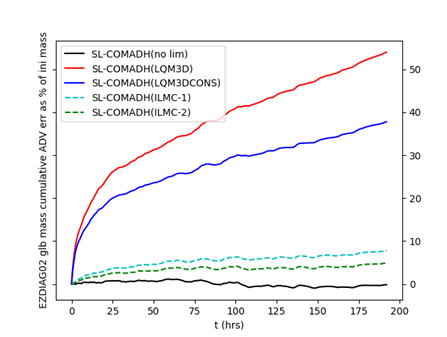 | 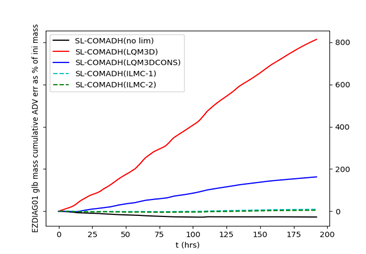 | 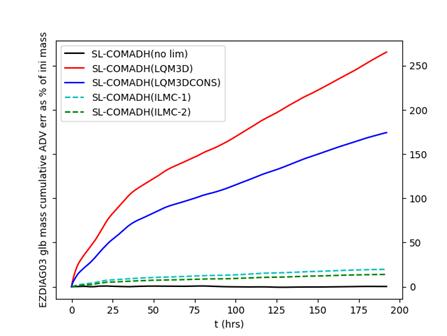 |
Figure 1. Mass conservation error growth (in percent of initial tracer mass) for the plume tracer passive advection test case. From left to right: tracer initialised near the east coast of China at (i) the near surface atmospheric level; (ii) at a model level near 30hPa height and (iii) at a model level in the upper troposphere near 260 hPa height. All tests have been conducted with the IFS model at 28km horizontal grid spacing and 137 vertical levels with cubic-Lagrange COMAD interpolation without mass fixer but with different limiters: no limiter (no lim), the operational CAMS 3D quasi-monotone limiter (LQM3D) and the improved limiters LQM3DCONS and ILMC developed in WP1 and WP2 of the CATRINE project (ILMC-1 and ILMC-2 denote the ILMC limiter with 1 and 2 iterations, respectively).
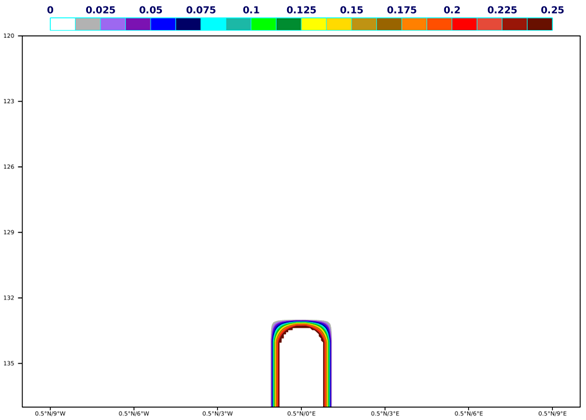
A further encouraging result for this limiter is its behaviour in idealised test cases designed to stress-test and expose weaknesses in semi-Lagrangian advection schemes by triggering rapid growth in mass conservation error under idealised conditions of symmetrically converging winds with little or no horizontal mixing, such as the warm-bubble test of Malardel and Ricard (QJRMS, 2015). Figure 2 breaks the warm-bubble tracer test into three panels: panel (a) shows a vertical cross-section of the initial tracer configuration, panels (b) and (c) show the tracer field evolution after 120 hours using the operational limiter and the ILMC limiter respectively. Panel (c) shows that the semi-Lagrangian scheme combined with the ILMC behaves closer to a conservative flux-form Eulerian method, improving the physical realism of near-surface transport.
 (a) | 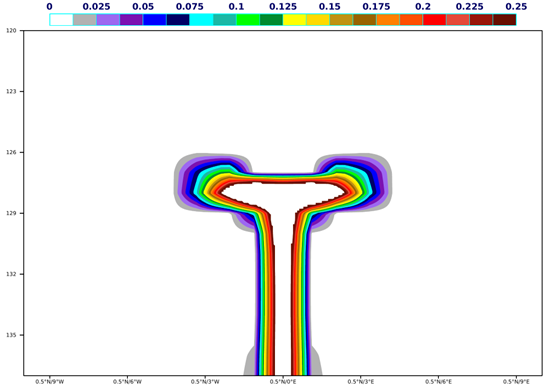 (b) | 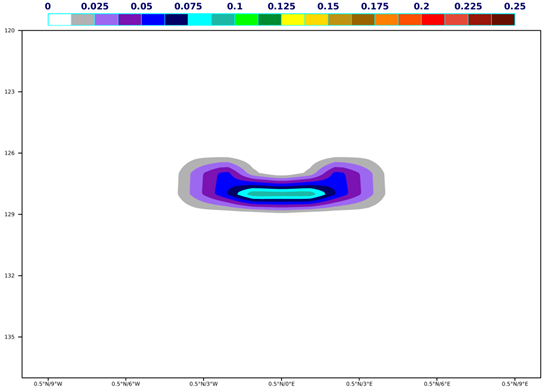 (c) |
Figure 2. Semi-Lagrangian advection of a tracer embedded in a warm bubble at coarse resolution (O80 grid 130km). (a): an East-West cross-section of the initial tracer concentration; the tracer is set to 1 at the lowest three levels - white in the colour area implies concentration values exceeding 0.25 (b): the same cross-section of the tracer concentration at t+120hrs from initial time with COMAD-cubic-Lagrange and LQM3D limiter (c): same as in (b) but using ILMC limiter.
Alongside ILMC, researchers advanced the development of the sweep-quadratic interpolation scheme, an alternative semi-Lagrangian interpolation method that offers improved computational efficiency for simulations involving many tracers. Early tests indicate that sweep maintains forecast skill and reduces mass conservation errors relative to the standard cubic-Lagrange interpolation method, while showing promising improvements in chemical tracer simulations, including reduced stratospheric ozone biases and improved transport characteristics.
Another key achievement is the completion of tangent-linear and adjoint (TL/AD) developments for several new transport components, including new limiters, the tracer mass fixer, and sweep interpolation. This is particularly important because CO2MVS inversions rely on 4D-VAR data assimilation, which requires accurate TL/AD representations of all model components. Researchers are also investigating new ways of representing atmospheric mass transport in IFS, including dry air mass conserving formulations of the continuity equation that may improve use of satellite observations. In parallel, inherently conserving and advanced high-order semi-Lagrangian transport methods are being explored for possible integration into future greenhouse-gas monitoring systems.
Taken together, these advances show how CATRINE is helping build a stronger foundation for next-generation atmospheric inversion systems. By reducing numerical transport errors and testing new locally conserving approaches, the project is improving the scientific tools needed to monitor anthropogenic greenhouse-gas emissions from both satellite and surface observations. Further validation is still required, but the latest WP2 results already highlight practical pathways towards more robust operational tracer transport modelling.
Article created by R.Phipps (ECMWF) using Copilot. To ensure accuracy it was reviewed by M. Diamantakis (ECMWF) and S. Malardel (MF).